Brazilian elections 2026
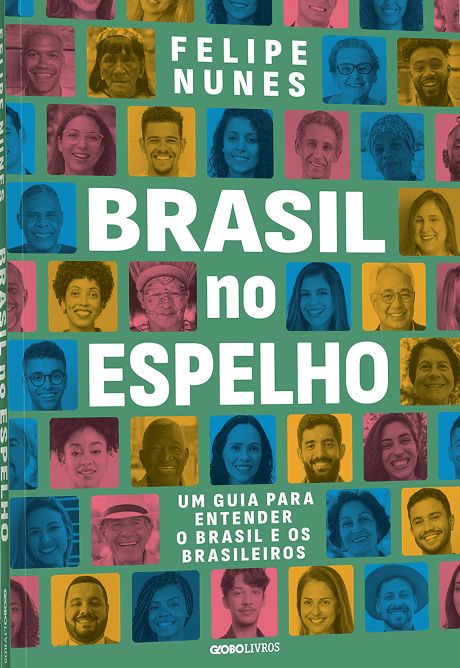
The book Brasil no Espelho by renowned pollster Felipe Nunes, based on comprehensive surveys, offers interesting insights into the voting behavior of various electoral groups in the latest presidential election. According to the book, in 2022 a relatively small group (5% of the electorate) of so-called social liberals tipped the scales in Lula’s favor. These were voters who had never voted for Lula or center-left parties, but for whom preserving democracy ultimately mattered more than day-to-day politics.
Brazil in the Mirror is based on surveys conducted by the polling institute Qaest, which questioned 9,994 people across all 26 Brazilian states (and the capital, Brasília) in late 2023. The author, Felipe Nunes, is one of the founders of Qaest. With this number of respondents, the typical sample size was exceeded by approximately five times, thereby providing rare insights into the values of Brazilians one year after the last presidential election, which took place in October 2022.
The book begins by noting that despite all global and national changes, Brazilians in 2023 think similarly to how they did in 1997, when a similarly large survey was conducted. Following a period of liberalization that lasted until around 2013, the country experienced a conservative wave that was both intensified and accelerated by the rise of the far right led by Jair Bolsonaro. This period also saw the strong growth of evangelical churches, the majority of which advocate a very conservative agenda and take a more assertive political stance than their Catholic counterparts.
Chapter 2 makes clear why Bolsonaro’s campaign slogan “Brasil acima de tudo, Deus acima de todos” (“Brazil above everything, God above all”) resonated so strongly in the 2018 elections. If there are two things that are sacred to Brazilians, they are God and family. 86% of Brazilians responded that “faith matters more than science,” and a 96% that “God is in control of their lives” (p. 28). Nunes argues that this is why, in the 2018 elections, Bolsonaro spoke far more about traditions and values than about the economy or political ideas.
Nevertheless, social attitudes are not static. Opinions on women, homosexuality, minorities, racism, and discrimination are changing, particularly among the younger generation, which the book refers to as “Generation .com” and which is more tolerant than older generations.
Despite the many things that divide Brazilians, there is broad agreement regarding the feeling of insecurity. “The fear of crime unites Brazilians, regardless of their social class … Insecurity is now a genuine Brazilian feeling (p. 103).” The issues of violence, crime, and drug trafficking also top the list of the most important issues for voters with 22%, followed by corruption with 18%. The economy, inflation, and unemployment come in third at 15%. This insecurity also has a major impact on personal relationships. “Mutual trust is extremely low: We Brazilians do not trust one another” (p. 112). Only 6.5% of Brazilians trust other people; in Norway, the figure is over 72%, in the U.S. 37%, and in Mexico still 10.5%. This mistrust of others also has negative effects on trust in institutions and thus hinders Brazil’s potential development—from economic growth to overcoming inequality.

Ideology and Politics
Brazilians talk a lot about polarization. The numbers back this up. Over the past two decades, Brazilian voters have increasingly identified with one political camp. While only 58% identified as either right-wing or left-wing in 2006, that figure had risen to 96% in the Qaest survey conducted in late 2023. When also the center is a possible option, a simple majority of 37% identifies with it—one percentage point less identify as right (36%) and 23% on the left. Brazil is therefore predominantly a center-right country. Why a center-left candidate nevertheless won for the third time in 2022 and will likely win for the fourth time in 2026 certainly has a lot to do with Lula’s personality, but in the 2022 and 2026 elections, it also has to do with how the far-right candidates were and are viewed by segments of the traditionally right-leaning electorate.
The Qaest survey divides Brazilian voters into nine categories, though the names are arbitrary.
1) Conservative Christians make up the largest voter group with 27%. The majority of this group are evangelical Christians, but it also includes more conservative Catholics who attend church regularly. 56% of this group attend church weekly. The vast majority voted for Jair Bolsonaro in 2018 and 2022. Their primary concern is “the defense of the family.” They hold very traditional views on gender roles and are strongly opposed to same-sex partnerships and the legalization of marijuana.
2) Welfare recipients or members of classes D and E (in Brazil, income groups are classified on a scale from A to E; D and E represent the lower middle class and the poorest segment of the population) constitute the second-largest group, comprising 23% of the population. The majority of this group lives in the Northeast and North. Many are recipients of government programs such as Bolsa Família (37%), Farmácia Popular, or Luz para Todos. This group is most concerned about the economic situation and is most affected by inflation and unemployment. They are the strongest advocates for a government committed to overcoming inequality and voted overwhelmingly for the PT and Lula.
3) Agro. With the commodities boom of recent deecades, this group has become a driving force of the Brazilian economy. This group includes the owners of large agricultural enterprises, as well as farmers, farmworkers, and people who identify with the Sertaneja culture. This group makes up 13% of the population and is concentrated in Central-Western Brazil, the South, and outside the major metropolitan areas of the states of São Paulo and Minas Gerais. They oppose stricter environmental laws and the demarcation of indigenous territories and have therefore been strong supporters of Jair Bolsonaro.
4) Progressives make up 12% of the Brazilian population. This group differs most from the rest of the population in its attitudes toward gender issues, family models, and matters of faith. While an average of 52% of Brazilians stated that a woman who has had an abortion should be arrested, only 3% of progressives agreed. They are also the group most concerned about climate change. A large majority of them voted for Lula in 2022.
5) One factor distinguishes the militant left from the rest of the population: they strongly identify with a political party (PT). They make up 7% of the population. Their level of education is above the Brazilian average and they are deeply engaged in politics. This group emerged primarily in response to the 2016 impeachment of Dilma Rousseff. They are the most optimistic regarding the economic situation.
6) Entrepreneurs. The country’s economic elite represents 6% of the population; they are overwhelmingly white, older, and live in the South and Southeast. They support privatization and oppose government social programs, and are generally satisfied with themselves and the world. They didn’t have problems voting for the extreme right.
7) Social liberals make up 5% of the population. In the first round of the 2022 election, the majority voted for Simone Tebet (MDB), who had described her candidacy as a “third way” between Lula and Bolsonaro. She received 4.16% in the first round and supported Lula in the second round. Social liberals support individual freedoms, a lean state, privatization (including of education and healthcare, with 89% in favor), and lower taxes, and have traditionally never voted for Lula or the PT. However, “they also advocate for global issues such as the defense of democracy and want Brazil to be perceived internationally as a respectable country. … Their greatest wish for Brazil is an end to polarization (p. 167).”
8) Self-employed individuals. These independent workers are part of the new economy, operating without a permanent employment contract. This group includes various forms of self-employment, ranging from internet influencers to Uber drivers. They support lower taxes, view the state with skepticism, advocate for individualism, and see wage disparities as an incentive for lower-income earners.
9) Extreme Right. This final category consists solely of individuals who are opposed to democracy. In many other respects, they overlap significantly with other conservative groups. They are religious and traditional, but unlike other conservatives, they would also support a dictatorship. Consequently, this group is small, comprising only 3%, and forms, so to speak, the most radical core of the Bolsonaristas.
In this polarized country, the voting behavior of the nine groups is actually quite predictable. Bolsonaro was elected by agro, conservative Christians, business owners, and the far right. “Lula won the election because he took the small group of social liberals away from Bolsonaro (p. 173).”
Outlook for the October 2026 Elections
The campaign for the presidential election, the first round of which will take place on 4 October, had developed into a neck-and-neck race between Flávio Bolsonaro and incumbent Lula as of 13 May. Just before 13 May, some polls even showed Flávio Bolsonaro leading in a potential runoff. By then, it appeared that Flávio Bolsonaro had secured the support of all traditional center-right and right-wing voters, including social liberals, to whom he likely seemed less extreme and anti-democratic than his father.

With the publication by the investigative online outlet The Intercept on 13 May and in the days that followed of WhatsApp and audio messages between Flávio Bolsonaro and the now-arrested criminal banker Daniel Vorcaro, the owner of Banco Master, the picture has fundamentally changed. Bolsonaro repeatedly referred to Vorcaro as “mermão,” a colloquial shortening of “meu irmão” (my brother), and asked for financial support of 134 million RS for a film about his father (of which 61 million RS were actually paid). In a text message sent one day before Vorcaro’s arrest, Bolsonaro wrote: “I am and always will be with you.”
Still days before the scandal became public, Bolsonaro wore T-shirts bearing the slogan “Pix is by Bolsonaro, Banco Master is by Lula.”
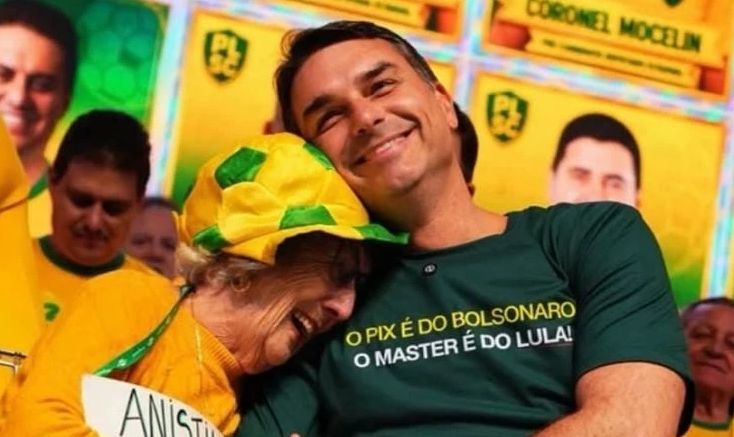
By mid-June, Flávio Bolsonaro had lost between 4 and 8 percentage points to Lula in the polls. This decline in support appears to extend beyond the social-liberals to include other conservative groups as well. The decline is more pronounced among evangelicals than in the general population. A Qaest poll from early June shows that among evangelicals—who are strategically important for Bolsonarism—support for Flávio Bolsonaro fell from 61% to 52%, while Lula’s rose from 24% to 31%. Under normal circumstances, a 4–8% gap is difficult to close by October. Consequently, there are already voices on the right suggesting a greater focus on the Chamber of Deputies and the Senate. Thus, it could be that while Lula clearly wins the election, he would face a right-wing majority in Congress at least as strong as the current one. Of course, neither outcome is decided yet, and more text and audio messages could further discredit Flávio Bolsonaro and the far right.